

Els Van Meerbeek
in conversation with Tine Van de Wiele
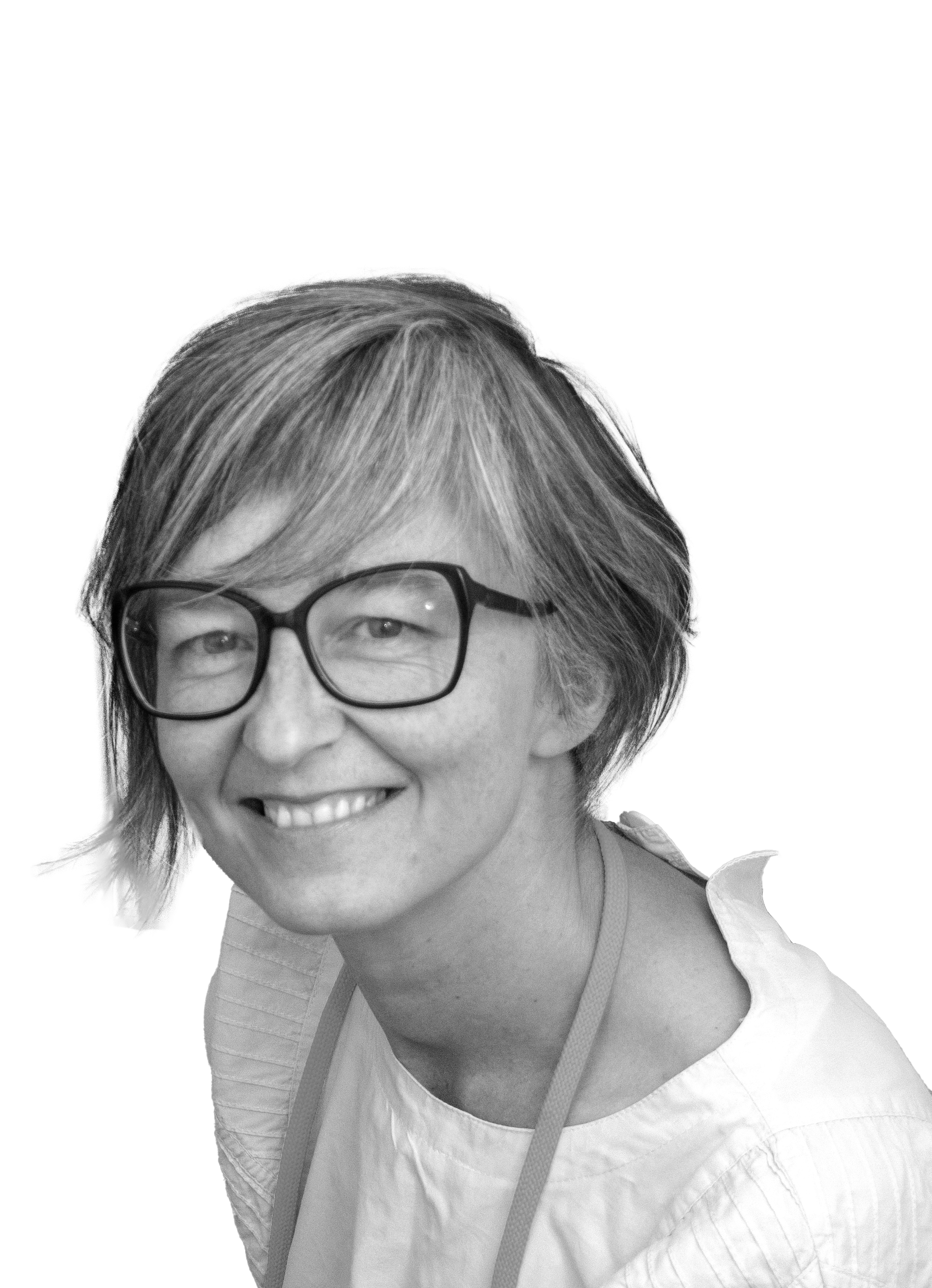
I’m glad we’ve always kept the joy of designing as a top priority
Tine Van de Wiele (TVdW)
When I was asked who I find inspiring and with whom I’d like to have a conversation, I immediately thought of you. I chose you because I’ve always been impressed by how you immediately started your own firm. You had young children at the time.
Els Van Meerbeek (EVM)
Yes, thanks so much for thinking of me – I feel very flattered.
The way we started our firm actually has its roots in the office where we got to know each other, the two of us. That’s the office of Paul and Henk. (De Smet Vermeulen Architecten) In Ghent, we were all colleagues there, a nice team. I also met my partner Joost there, and we just started doing small projects together in our spare time, out of a kind of design joy – not really with a big ambition of starting our own firm, but more like, hey, it’s fun to design a cabin or the interior of an office together. It was very small-scale, but it was something we enjoyed doing.
Then we won a competition we entered with someone else – it was actually one of those "Open Call" competitions for a school in Bruges. At that point, we realized, this is getting serious – we should start treating it more seriously. That’s when we decided to start a firm.
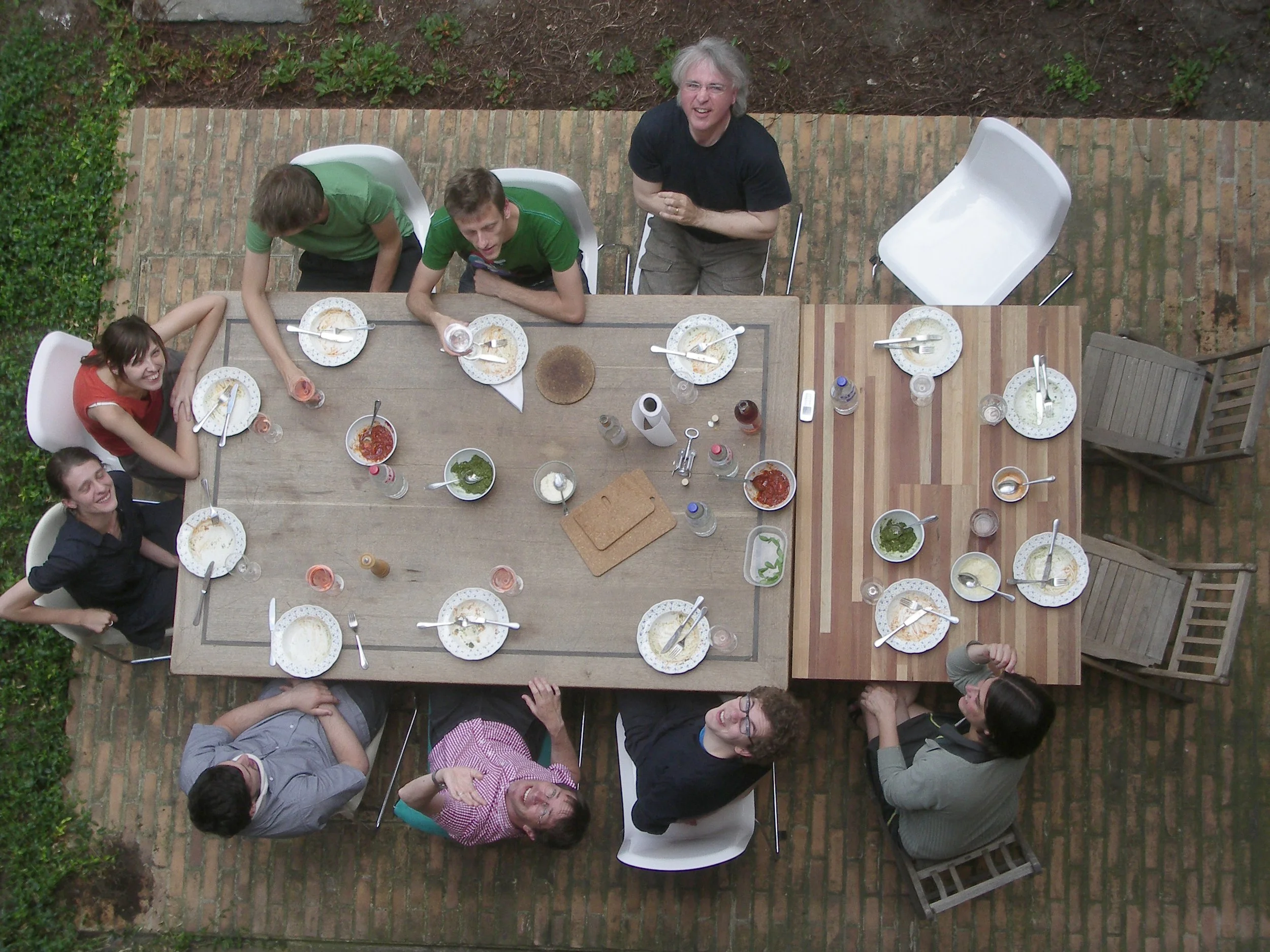
De Smet Vermeulen architecten circa 2010
📷© Credit
EVM
We worked just the two of us for a long time, then one person joined, and now we’ve had four employees for quite a while. Joost is a co-partner, but the structure of our office is actually very horizontal. We never split things into specific roles – we do most things together. And from that perspective, the firm has grown. And we’ve always worked from Brussels – the firm is really tied to that location.
And now, for the past five years, I’ve started teaching again. I realized that through my experience and expertise, it’s really nice to share that with the next generation. A vacancy opened up, which also included a research component. I thought, OK, I’ll just combine the two.
It is time-intensive – not easy – but there’s a lot of overlap, which is actually nice. The things you learn in the office or experience as a practicing architect, you can immediately pass on to students. The research focuses on drawing. It’s great to pass that on to students, but it also affects how we draw within the office.
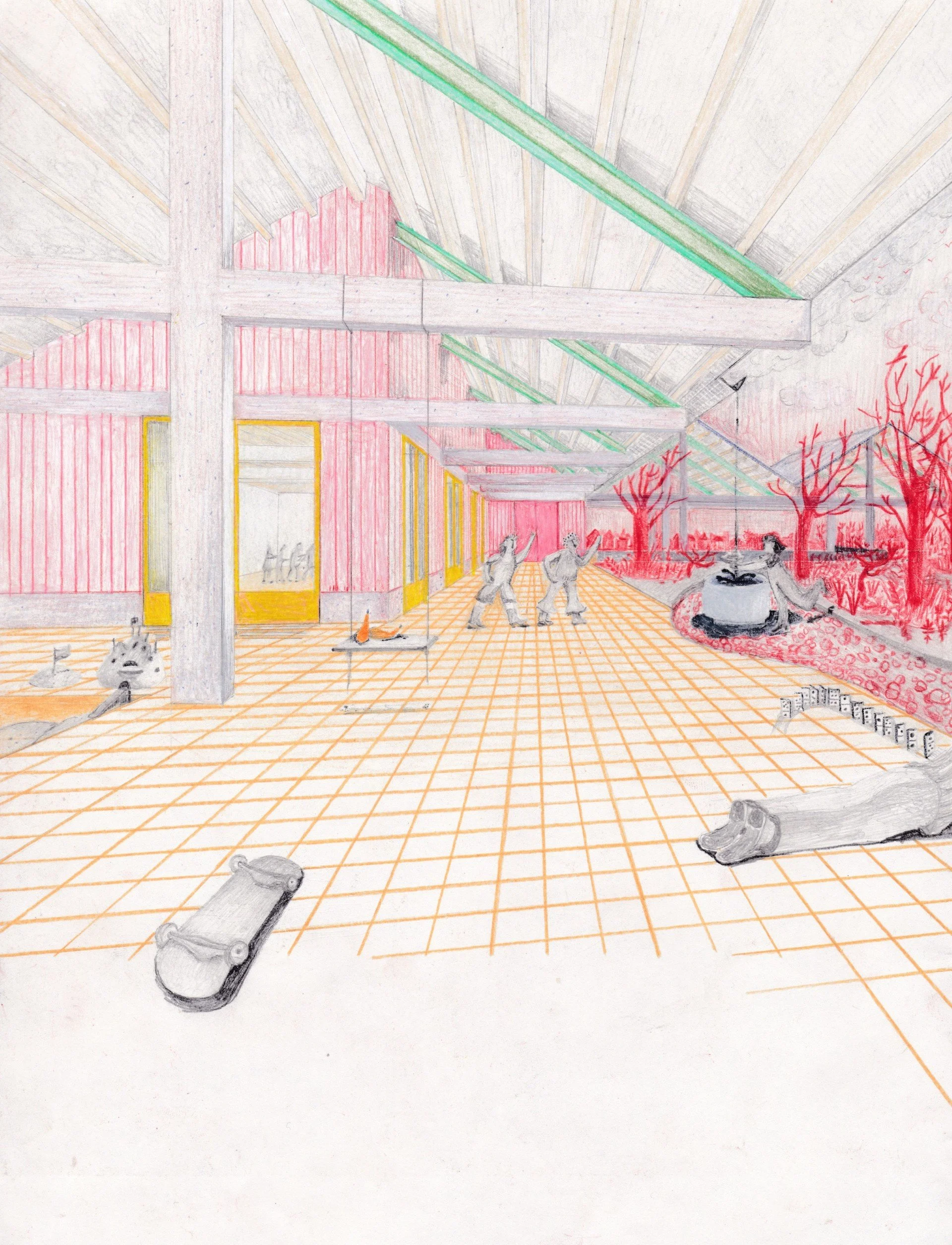
Kappaert School, Zwevegem (Carton123 architecten and Pauline Vermeulen)
There’s a growing awareness of what drawing can mean for design in practice, and that only deepens through research. Luckily, we have a great team – we’re six in total – and for now, my contribution to the office is a bit less until the research is completed in a few months. In the meantime, the others are taking on a lot. It will never be more than 50-50, because I find it really important to stay involved in practice. Even if I focus more on overarching tasks, I really want to stay 50% in practice – that’s always been the goal.
We enjoy that variety in projects. It’s a completely different dynamic, and the interaction with private clients is also very different from dealing with professional public clients.
In Brussels, the public clients are represented by a project manager who approaches things differently than a private client. What’s nice about public commissions is that you can contribute to something that adds value to a larger neighborhood. And there’s still a lot of work to be done – many things that can be improved. But public commissions don’t just fall in your lap. You really have to go looking for them. You can tell people you're interested and have certain expertise – and we’re still managing to win them – but it remains something you have to keep working at.
TVdW
Do you collaborate with other firms?
EVM
Often, yes. It depends on the expertise or references they ask for. That also shapes how you form your team.
Specifically in the Brussels context, we often collaborate with French-speaking colleagues – that way, we cover both languages. We’re comfortable working in French, and vice versa – the French-speaking firms are fluent in Dutch. It’s definitely not just about language – the collaboration is also about reflecting together on the design.
It’s no longer one-on-one, just pulling ideas from your own hat. Collaboration means your work gets challenged. When working with another firm, you're almost twice as critical. It’s nice that a design is really carried by more than one person.
Also, in the private market in Brussels, there are still many row houses and strange constructions that are part of the city’s heritage. There’s still a lot of work to be done there. The projects go beyond just adding a kitchen or living room. We often get to play with floor levels or think about the transition from public to private. Even a small project can have meaning in a broader sense.
TVdW
Do you see more and more projects focusing on circular reuse of typologies, or reprogramming of functions?
EVM
There’s definitely more awareness.
Brussels has a big surplus of large office buildings, but clients still often prefer new office buildings rather than dealing with what’s already there. As a result, there are many studies about how to convert vacant office buildings into housing or other programs.
In the European Quarter, there are quite a few such projects – ongoing or in competition stages – but we haven’t participated in those yet. But you do see that within Brussels, there’s a strong focus on environmental care, and on choosing the right materials for the construction site. You try to keep the environmental impact as low as possible – and in that area, Brussels has stricter policies than the rest of Flanders.
Yes, it takes effort, but it pays off.
We love the urban context. You have to start from what’s already there – the budgets are never super high – so you have to match them. What can I do within this budget, in this location? You don’t start from a blank page, and you know you have to be inventive and think outside the box. The specific Brussels context lends itself well to that. Brussels really feels like a laboratory. We often say: if it works here, it’ll work elsewhere too. Brussels feels like a place for testing things.
TVdW
Earlier in our conversation, you briefly spoke about the ‘Open Call’ system…?
EVM
Essentially, it requires that every public assignment of a certain scale must go through this procedure. It happens in different steps: first, the municipal governments approach the Flemish Government Architect and express their interest in building a certain structure. They want to organize a competition for it, and the architect helps organize it. Then a call is launched — an open call to which you can apply as a design office. You submit a few references, but actually, the initial selection criteria are quite limited, which allows younger firms, even those with few or no references, to apply.
Then, a limited competition is held with three to five selected offices. Within that group, there can be a lot of variation — you always get a mix of young offices, more established ones, and even international offices that bring refreshing perspectives on certain programs. You receive a fee to participate in the competition. It’s not super generous and doesn’t cover everything, so it’s still a bit of an investment.
The municipalities don’t necessarily choose a design; more often, they choose a designer. It’s not like your design from the competition can’t be changed — it’s important to already have a conversation with the client in the first phase. What’s also really nice about the system is that it operates at a fairly high professional level from the start.
TVdW
You run your office with Joost, who is also your partner in your personal life. Is there a division of roles between yourselves?
Do you experience any limitations or opportunities specifically related to gender? Do you notice, for example in meetings, that you are treated differently from Joost?
EVM
I’ve personally experienced very little where I felt I was being disadvantaged because I’m a woman. But I have heard stories from colleagues — often younger women — who experience this on construction sites, which still tend to be a male-dominated environment. But we learn to stand our ground and try not to take it too personally.
I’ve also never felt like there was some kind of glass ceiling. Luckily, within the administration in Brussels, you work daily with quite a few women.
In our own office — I had to laugh earlier — today we were just two men and one woman in the office, but actually, we’re four women and two men. So the balance isn’t quite fifty-fifty. I’m more focused on how a project can connect to something in the neighborhood. I want to learn more about it and start researching it immediately.
For me, it’s more about the overarching view — I look for the links that always exist in a design, or how the design relates to the surroundings — more the holistic themes.
We’re more complementary in that sense, but within the whole office — the six of us — we’re all different. It’s also nice because we learn from each other. There’s no competition. So it’s really nice that within the office we can cover all those different skills.
It’s even the case that when we do a competition and need to create a visual, we almost never bring in someone external to make a perfect Photoshop image. That’s not really something we’re great at. Instead, we might make a drawing, or a collage, or a model, and then photograph it. We try to work with the skills we have in-house.
That’s why it’s strange that sometimes, in order to be allowed to design a certain program, you're asked to show seven examples you’ve already done in that area. That doesn’t always make sense — it’s precisely because you haven’t done it before that you can approach it in a fresh way.
Most of our work revolves around care — in the broad sense: caring for people — daycare centers, youth centers, community centers, and projects where more than one household lives together — collective housing.
TVdW
What advice would you give your younger self, knowing what you know now?
EVM
I don’t think I would do many things differently. I’m still happy with how things turned out — the variety of projects, not narrowing into one specialization but keeping it broad.
On the other hand, we are a firm of six people now, and that requires a certain level of professionalization. It’s important not to wait too long with that. There’s more to it than just the joy of designing. There also needs to be a solid model.
We love our work, but there’s also life outside the office, and that comes with a certain responsibility.
I’m glad we’ve always kept the joy of designing as a top priority. Even when things were tough, we managed to avoid taking on assignments that didn’t suit us — like the legalization of a veranda, which may pay well but brings very little design joy. It’s important to do something you enjoy, because it shows in your work.
We try to avoid predicting where we’ll be in a few years. We’re in the present — day in, day out. Even when a building turns out well, it’s nice to see the result, but it’s even more special when the users come in and the building comes to life. It’s great to go back sometimes and see that people enjoy being in those older buildings. That’s kind of my advice to myself.
The students I teach are in their first year, and some of them are still very enthusiastic. I try to nurture that as much as I can. They’re still very young — they can’t draw perfect plans or sections yet — but I always see a spark, and I try to guide them as best I can to improve their work.
Els van Meerbeek is a Belgian architect and academic and with experience in practice, education and research. Founding her own practice, Carton123 architecten with partner Joost Raes in 2008, Els is also involved with academic programs in Holland and Belgium as a lecturer and as a researcher. @carton123_architecten
Tine Wan de Wiele is an architect at Wardle, working across health and education sectors with a keen interest in creating and delivering sustainable and socially responsive design outcomes. Tine is also Belgian and worked with Els at De Smet Vermeulen architecten in Ghent for a few years where they developed a close working relationship and friendship.