

Emma Jackson
in conversation with Megan Fraser
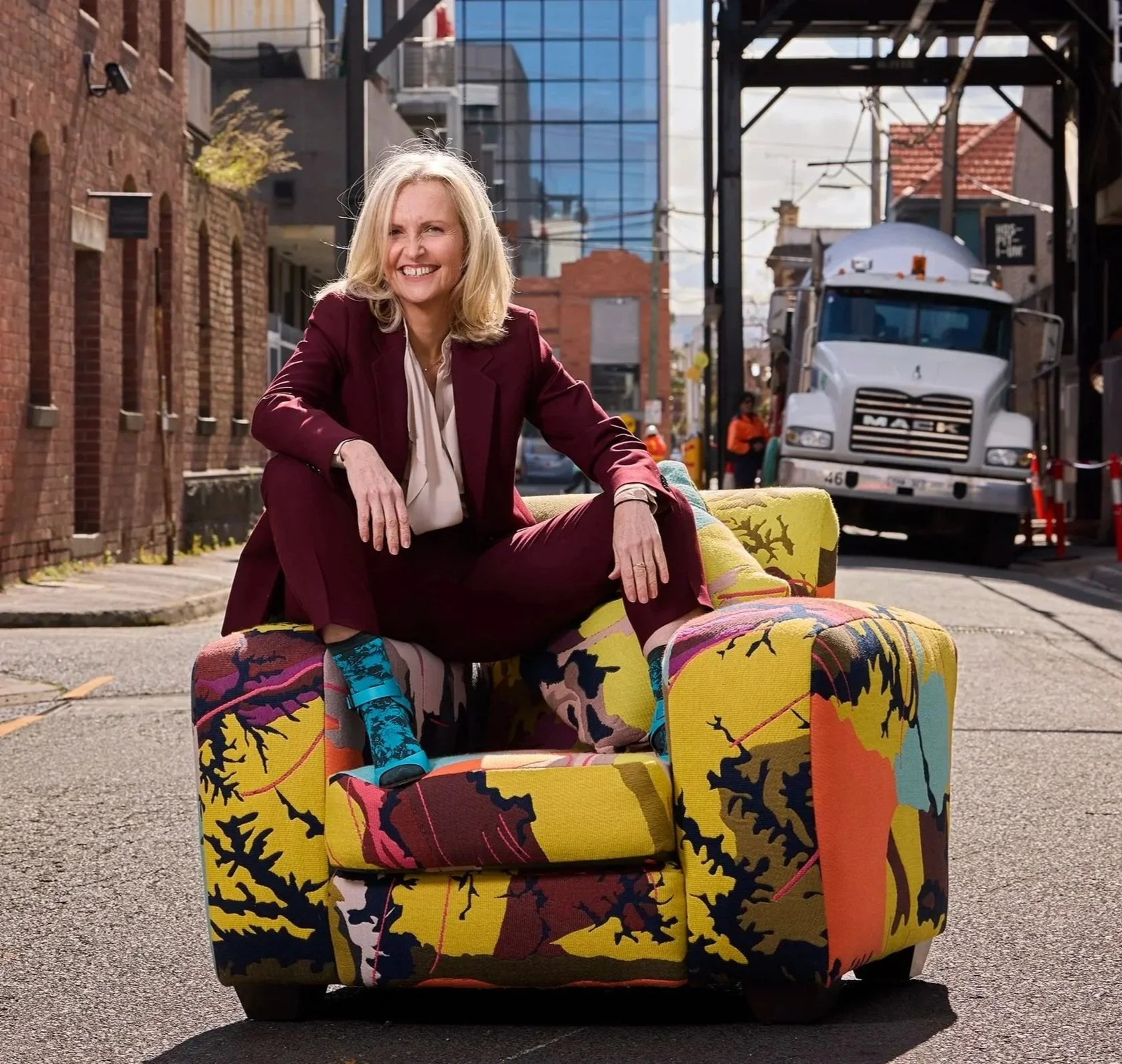
I think the lens of science and geology allowed me to find a way of accessing design that was purely driven by wonder
Megan Fraser (MF)
You've done so many different, amazing things. You've been in science and architecture and academia and now textiles. It'd be interesting to hear, when you were starting out at university all those years ago, what did you think your career or your future would look like?
Emma Jackson (EJ)
I wanted to do so many things; it was actually exciting and stressful. I remember going to the career’s day, where we had to pick up pamphlets on different, you know, possible careers and I bought them all home!
My dad was a geologist and so I was geared up to go into mining engineering. I got into the Kalgoorlie School of Mines, got a scholarship. I was the only 17 year old and the only female, in a town full of men.
MF
Was that a bit daunting?
EJ
It was, oh, it really was. That was too much, as a 17 year old to deal with, beyond the field of study. In hindsight, I should have just toughed it out. I left, but I did continue doing science, chemistry and math, and but it wasn't quite me. I'm quite science brained; there was still something that wasn't being met. I applied for architecture and got in and I felt that was my crowd. There was just something about being able to think a bit bigger, which I liked.
MF
You finished your course and then I understand you moved to Melbourne.
EJ
I finished my course. I worked for Kerry Hill for a while in Singapore. And then moved to Melbourne and worked for Lyons.
MF
And at that point, did you kind of feel that architecture was your forever career?
EJ
I definitely thought it was a forever career. I think there's something about creating the new and I was lucky, really lucky with the opportunities I got at Lyons and all the offices where I worked. I did get to design, and I was thinking about those things - new ideas and getting to test materiality.
MF
In any firm, it’s good to be able to get to that point. So often you get stuck in documentation and delivery and schedule land. That's cool that you were in kind of the design space.
EJ
There were very few women in that space, and you met some interesting characters in that space. And you have to be prepared to deal with, getting your elbows on the table.
MF
Yes. Do you see that as being one of your strengths?
EJ
No, definitely not. I wish it was. I think I was good at design. I think I was very competent at what I did, but I did struggle with that aspect of it, but I kept persevering because I kept thinking, gosh, if I don't do it, then what? Who will young women see working in the design space?
It's an interesting space to navigate because I think when you're in that realm of ideas, where you're prepared to entertain anything, it comes with a particular type of mind. And they can be incredibly exciting minds to sort of collaborate with, but it can also be a little bit intimidating as well. So that was another aspect of what you have to deal with at that pointy end of design.
MF
I understand that you transitioned into academia and became more affiliated with RMIT. What was the reason for that shift rather than pursuing what you were doing?
EJ
There's something about the cyclical nature of it, that maybe just didn't suit my personality. You finished a job and then you're onto the next one and then you're on to the next one. And while you were still engaged in the world of ideas, there was something a little bit routine about it. I wanted to be more engaged with the world of ideas and to push that a little bit further.
RMIT had been asking whether I'd be interested in a full-time position. I eventually did a PhD. Which I never would have done, because my nature is to kind of be broad and pursue lots of different things. I took that opportunity to do something I really enjoyed and look at a part of the world that I'd like to spend more time in, which was the Northwest of WA.
MF
With that PhD, you dived back into the world of geology and science. I know you already had a lot of a lot of knowledge from your science degree and your family history, working in geology. But did you then go back and study?
EJ
Yes, I collaborated with other scientists who were kind of doing that. I had lots of conversations with my dad who is a geologist, and he's also got a kind of mad scientist personality. It enabled me to realise that I'd made a bit of a stereotype about science, because the more I delved into this experimental research area of science, exploring new things, I realised it is as hairbrained as some of the ideas in architecture.
It’s kind of loose thinking, and it is like, well, what if we do this and that? And that's nuts, but, you know, having nuts ideas and having them fail means that you get information and the outcomes lead to something else.
It was throwing ideas at the wall and seeing what stuck and what didn't. I think it was a nice confluence of being able to marry the science and the design without it having the tension that I thought it would have and realising that in both disciplines there is this kind of experimental thinking.
MF
Did the students also get a lot out of that?
EJ
I think so, yeah, I think they loved it. Yeah, they really did because in Melbourne you don’t think about the geology all that much.
MF
Yeah, sounds really cool. I think I would have liked to have done a studio like that.
EJ
I like that idea of reading the ground and letting the science or something else influence the design, and it not being driven necessarily by aesthetics. I didn't go into architecture as a very stylish person. I was a bit of a dag and I didn't really change, I didn't dye my hair red, I didn't wear cool band t-shirts. I didn't do any of that stuff. I have always buffed against that sort of super stunning design driven thing. I think the lens of science and geology allowed me to find a way of accessing design that was purely driven by wonder. You then follow that track, the information or the stories in the idea and you've found and worked out how that can be translated into a design object.
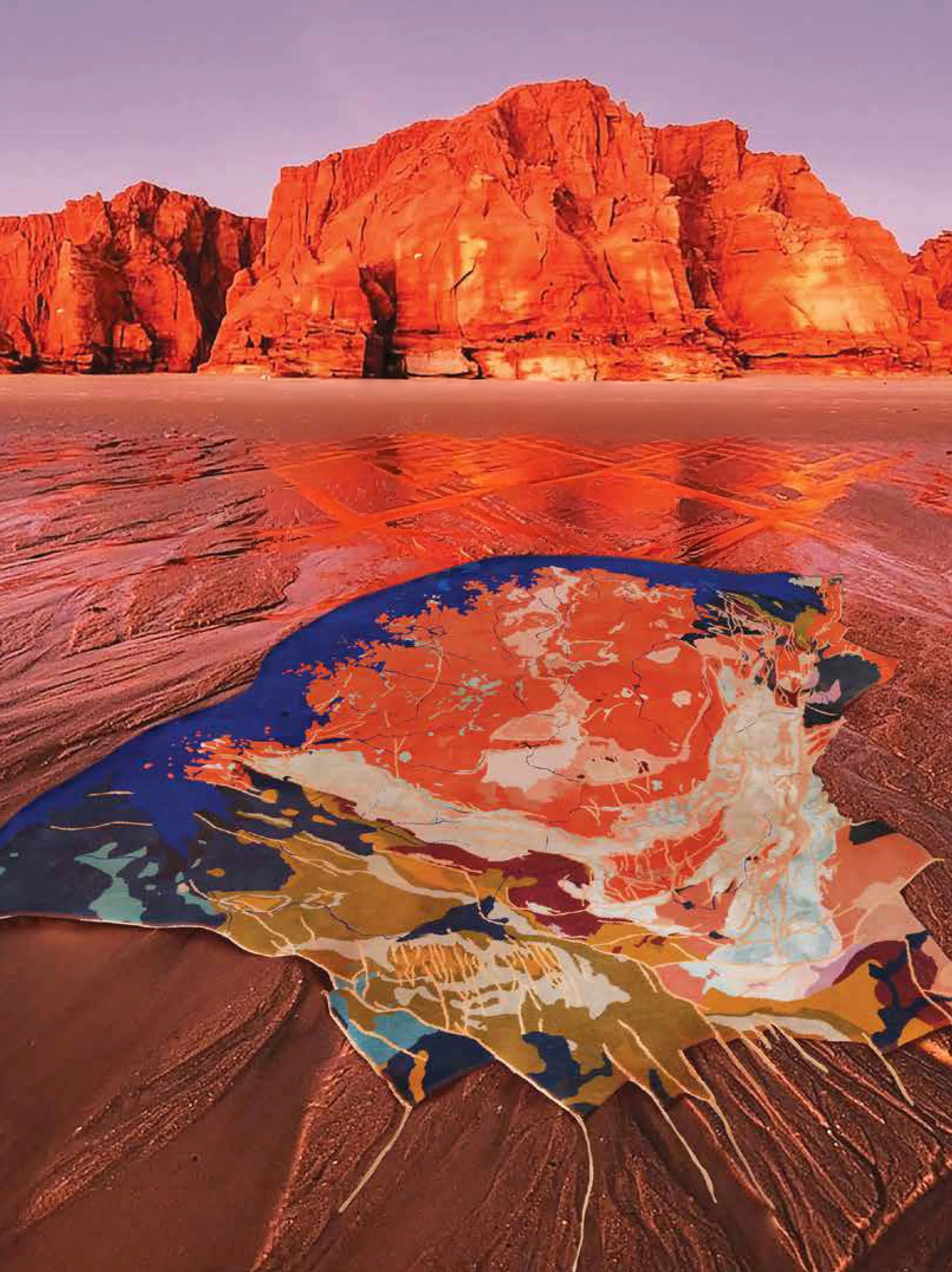
Sea Wasp on Kimberly ground Emma Jackson
MF
Quite an interesting circle, for someone who doesn’t consider themselves to be particularly style driven person…Maybe we'll take a step back. What led you to change tack and move away from academia into textiles and fabrics. Was it the tapestry competition?
EJ
I was the program manager of the Bachelor of Architecture at the time, because of the pandemic and the load on the administration staff, I couldn't teach. I was absolutely up to my eyeballs in administration and trying to make things work online.
I thought, I've got a lot of energy, I want something that I can get my teeth into that's going to keep me really stimulated for the next 20, 30 years. I started picking up where I left off with my PhD. I entered Tapestry Design Prize for Architects in 2021 with a geological study of the east coast of Australia, with a call to architects to say, look at the ground, that we build into. I won some prize money, which enabled me to start up something. I just kept drawing and designing the geology of Australia. From the East Coast I just moved across the continent. And I kept at it, and it became an obsession!
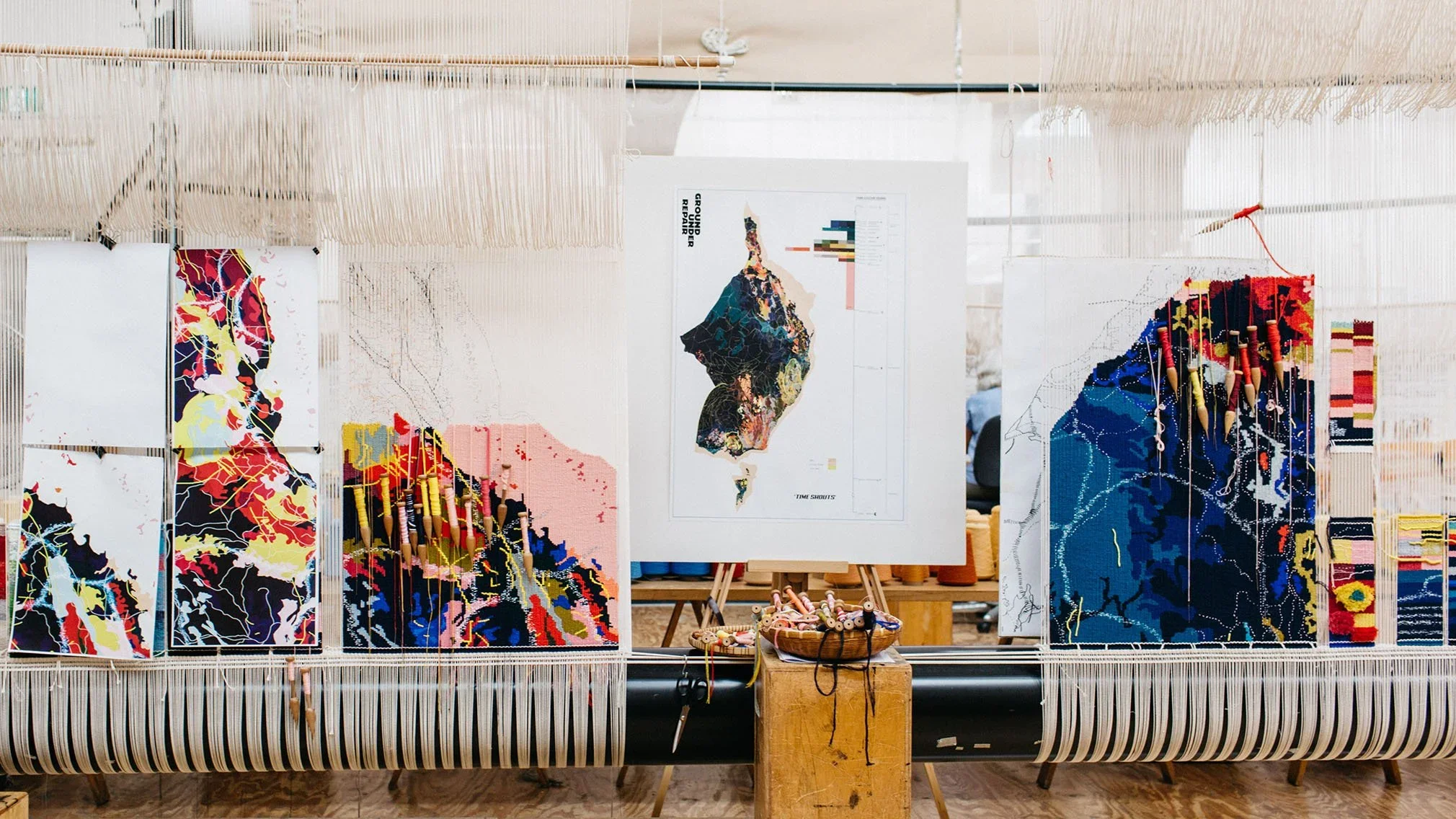
Tapestry studies for 2021 winning design ‘Time Shouts’ on the loom at the Australian Tapestry Workshop Photo: Arini Byng.
MF
What was the intention originally? Was the idea that these would become more tapestries or did you quickly think these would be amazing rugs or fabrics?
EJ
I didn't think it would be tapestries because I knew how expensive they were. And that you couldn't build a business around that because they're just incredibly expensive and take a very long time to make and there's quite a long waiting list. I thought rugs, definitely! For my PhD, I was going to get a rug made for the exhibition. I had priced getting a rug made of the geology of the Pilbra.
MF
You're moving into your new studio and shopfront soon? What else is on the horizon? Is it the plan to continue expanding or developing new collections or….
EJ
I think so. There's a really strong educational aspect to this for me, because I love teaching. It's not just to be a beautiful object. They are supposed to reveal something about the beauty of our country. When we get into that space, I probably will run sort of workshops or talks, because that would be very rewarding, part of this is a connection to something bigger than us. I think that's the thing that really drives it for me.
There's just nothing for me that beats getting out into remote Australia. It's just, it's sort of slightly dangerous. You feel small. Everything that you worry about at home disappears. I think it's the scale. Whenever I get out of the city, it's the scale and how small as a person you are compared to everything else that's surrounding you. It feels like relief.
For me there's an aspect of “why don't we adorn our spaces with soft furnishings that mean something to us and our stories”. Not just cool fabrics. It's supposed to be beyond cool, it's supposed to be cool for a really long time.
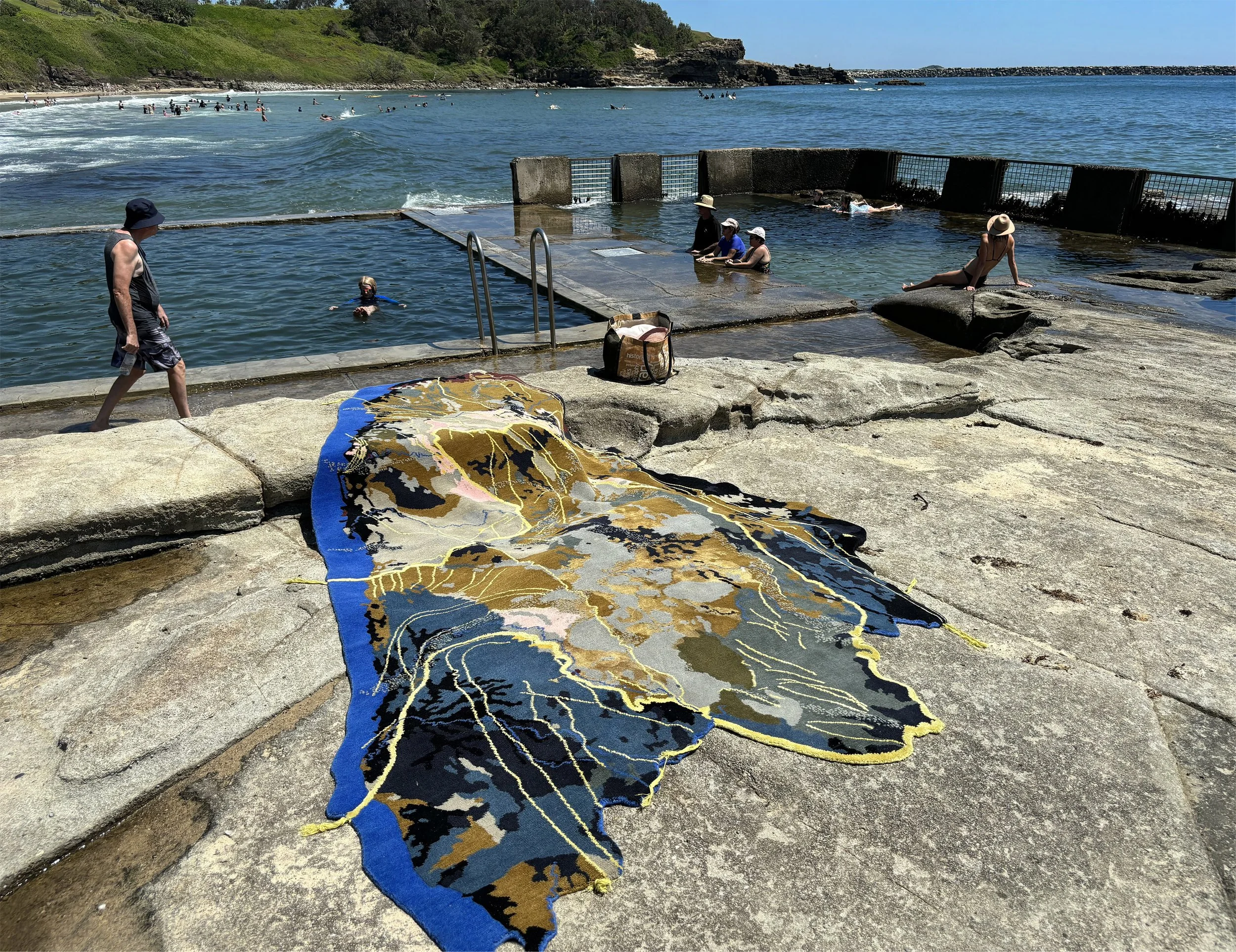
Time Traveller at Yamba coast Emma Jackson
MF
So how do you go about getting these made? Are you making the fabrics yourself or testing them out yourself?
EJ
The fabrics are made in Belgium. We sourced a jacquard loom because it was really important that they’re not printed. It's woven in a very particular way, the patterns are woven in, the colours are woven in. No one colour is a colour. It's like paint.
MF
It is almost like the soil.
EJ
It is. It is. It's sort of geology that you can touch, and the different geology types feel different.
MF
Do you have any advice or words of wisdom that you would like to give your younger self, knowing what, you know now,
EJ
I lacked a lot of confidence that I didn't need to lack. I think you'd probably find a lot of women my age would say the same thing. Like, there's something that happens in your 50s where you just, whether you're confident and off you just, you don't care. You just give it a crack. Yeah. And I wish I'd had that when I was younger. Yeah. I think I wish I'd just been able to barge on forward without worrying that I wasn't, you know, this enough or that enough.
When I was teaching, I would really try to impress upon young women that it's great to get good marks, and yes, it's great to be diligent, and to try and get everything right. But… if you could just get a bit of gusto, because that's going to help you in an office. You'll have a better career if you can speak up with confidence. It’s as important as an HD. I mean, if you can do both, that's great.
There's something about that spunk and confidence that you really need. There's no one way to do it. I think you can do it quietly If you're a quiet person. And I think you can do it loudly if you're a loud person. I don't think you have to do it like a man would do it, but yeah, I think it's important.
MF
I think that's really good advice. Thankyou!
Emma is a creative practitioner, a trained architect, designer, and scientist. Emma has conceived, launched, and positioned a creative practice from the ground up, taking calculated risks to establish visibility in highly competitive cultural and design spheres. She’s equally comfortable operating in the realm of big ideas, while staying grounded in the realities of the commercial world.
Megan is a an architect at Wardle, working predominantly within the residential and hospitality sectors. A creative thinker with a technical bent, she has a keen eye for detail and tenacity for resolving bespoke complex three dimensional problems. Meg is widely known in the studio for her willingness to foster relationships and mentor staff while juggling project priorities.